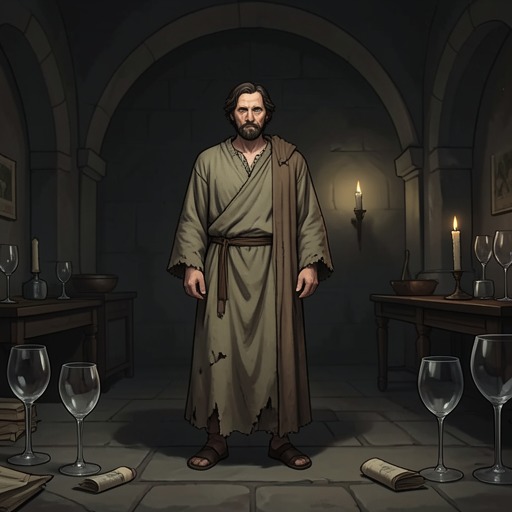
Roderick O’Conor’s solitary drinking after the feast
Finnegans WakeAfter the communal feast at Glenfinnisk, Roderick O’Conor is left alone among the wine-spill and discarded drinking vessels; he drinks what remains and ends slumped on his throne. The episode makes the sovereign’s grandeur inseparable from loneliness, intoxication, and physical collapse, turning the aftermath of a royal gathering into a grotesque, uncertain passage toward morning.
Feast and Abandonment
The gathering is described as a long-remembered thanksgiving-day get-together at Glenfinnisk-en-la-Valle, held on the anniversary of Roderick’s “finst homy commulion.” It is also called a “last supper,” hosted in his shadowy house of a hundred bottles, with its radio-beamer tower, hangars, chimneys, and equine imagery. Once the guests have gone, the feast’s public fellowship gives way to the king’s solitude.
Roderick is introduced with deliberately unstable royal credentials: he is called the paramount chief and last pre-electric king of Ireland, yet the narration immediately qualifies what “last” can mean, recalling an earlier king, Arthur Mockmorrow Koughenough, of the Taharan dynasty. Roderick is said to be somewhere between fifty-odd and fifty-even years old. The comic uncertainty surrounding his age and rank makes kingship less a secure historical fact than a title repeatedly inflated, revised, and passed on.
The King Among the Remains
The departing company disperses toward its own mud castles, on foot and in extended order, while Roderick remains in his grand old inherited pile. The narration sweeps together Parthalonians, Firbolgs, Tuatha de Danaan, people from Clane, and other groups in a mock-epic roll call; he is said not to care a royal spit for them. Against this pageant of collective departure, his movement is small and solitary: he heel-taps through the wine-spill and weevily corks gathered around his table.
His clothes and bearing are assembled from a jumble of borrowed-sounding details: a Roderick Random pull-on hat, Mike Brady’s shirt, Greene’s linnet collar, Ghenter’s gauntlets, a Macclefield swash, ready-made Reillys, and a pan-European poncho. The catalogue makes the king’s body look less like a sealed emblem of authority than a comic assemblage, overdressed and exposed amid the mess of the feast. The story calls him overwhelmed, “like a sponge out of water,” as he addresses an imagined company and sings through tears in several tongues.
Drinking and Collapse
Roderick’s solitary drinking begins with the leftovers rather than a fresh royal serving. With a midnight thirst upon him, he sucks up the surplus drink left at the bottoms of the guests’ vessels, assisted by his “venerated tongue.” The remnants include Guinness’s, Phoenix Brewery stout, John Jameson and Sons, Roob Coccola, and O’Connell’s Dublin ale. Their variety turns the table into a miniature inventory of Irish drink and commerce; the king’s appetite draws no distinction among its contents.
The narrator estimates that the accumulated quantities amount to considerably more than the better part of a gill or naggin by imperial measure. Roderick’s excess is at once grandly toasted and physically debasing: his “charmed life” is celebrated as he scavenges the dregs, and the narration figures him as a “toper” in the middle of the wreckage. His royal status does not spare him the ordinary materiality of thirst, drink, and a body overcome.
The scene ends not with a formal abdication or a narrated death, but with a fall into the seat of power. After a dense, fragmentary passage of paired voices and nautical-sounding commands, Roderick “just slumped to throne.” The throne survives as the destination of his collapse, so that the image can be read both as comic restoration to office and as a king reduced to inert weight upon it.
Dawn and Recurrence
The narration stretches the aftermath toward daybreak: the king remains among the candles and the gaze of a figure described as an adornment of his album and a father of families, while the morning is anticipated through a beacon egg, stained windows, and the restarting of activity after silence. This forecast of a restart prevents the episode from settling into a simple ending. Roderick’s collapse belongs to a night that gives way to a new day, and the text links the recurrence to his ancestors as well as those who follow him.
The abrupt coda shifts from the king’s slumping body to the stout ship Nansy Hans, sailing away from Liff toward Nattenlaender, and closes with leave-taking and return: “As who has come returns.” That movement carries the episode beyond a single monarch’s drunken aftermath. The feast disperses, the king falls, and the narrative itself sails onward, making the episode’s ending another turn in a world where departures and returns, collapse and continuation, keep touching.